
Buffalo & Erie County tree work
Tree Removal in Buffalo, NY
Big trees taken down piece by piece on tight city lots, storm damage cleared and stumps ground out, all priced in writing before anything is cut.
- Free estimates, in person, for homes in Buffalo and Erie County
- Line-item quote you can compare
- Wood, brush and stump plan settled up front
Taking Trees Down Where Lake Erie Sets the Rules
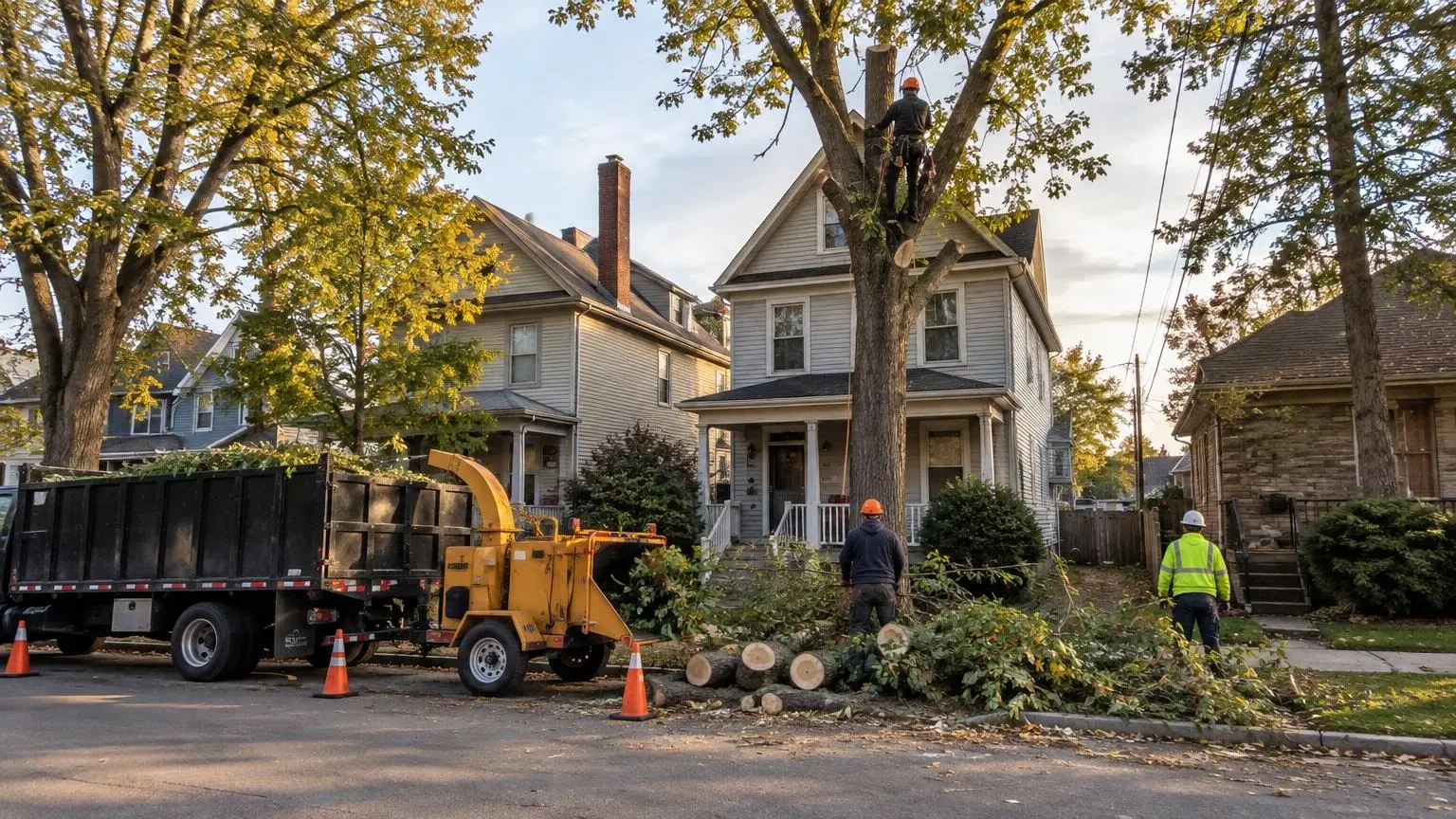
Tree removal in Buffalo is shaped by the lake. The city averages roughly 95 inches of snow a year, much of it lake-effect off Lake Erie, and the strong southwest winds that come across the water have a long record of knocking trees over: on November 6, 1990, the National Weather Service measured a 61 mph gust at the Buffalo airport, with trees and power lines down across the region. Put that weather together with a city where most houses were built before 1940, on lots so narrow that a double and its neighbor are separated by one driveway, and a mature maple or ash almost never has open ground to fall into. Most of what we do is taking those trees apart from the top down, lowering each piece where it can land safely, and leaving the roof next door untouched.
What October 2006 taught Buffalo about trees
On October 12 and 13, 2006, more than 22 inches of heavy snow fell on Buffalo while the trees still had their leaves. Limbs and whole crowns broke across the city, wires came down with them, and hundreds of thousands of customers lost power. A National Grid official later said the city lost its tree canopy, and the volunteer group Re-Tree WNY has planted more than 30,000 trees since 2007 to replace what was lost. Many trees that survived that storm still carry its marks: stubs where big limbs tore out, and decay that worked in through those wounds and now shows up as hollows, conks or soft wood at old breaks. When we look at an older Buffalo tree, we look for those scars.
Ash and beech are both in decline
Emerald ash borer was first confirmed in Erie County in June 2011, in a few trees in South Park in South Buffalo, and it showed up near the airport in Lancaster the same year. By 2016, reporting from the county put ash at about one in five trees, and towns were spending real money on them: Amherst budgeted $500,000 to save 9,000 ash, and Cheektowaga took down 200 infested ash in its town park. An ash killed by the borer dries out and turns brittle, so a removal that is routine while the tree is alive can turn into a job for an aerial lift or a crane once it has stood dead for a few seasons. Beech is next in line. Beech leaf disease reached Erie County in 2019, has no known treatment, and can kill a mature beech within six to ten years.
A city full of maples
A U.S. Forest Service study of street trees in four cities, Buffalo among them, found that Norway maple made up more than 36 percent of the large trees and maples of all kinds more than 54 percent. Maples are why so many Buffalo streets feel shaded, and they are also why so many storm calls involve one. Norway maples carry dense crowns that hold wet snow, and they often develop girdling roots that choke the trunk at the soil line. Silver maples grow fast and have weak wood with tight forks that split. The black spots many people see on maple leaves in late summer are tar spot, which the city's Forestry office notes is not lethal.
Whose tree is it?
In Buffalo, the strip between the sidewalk and the curb belongs to the city, and so do the trees in it. The Bureau of Forestry takes requests through 311 and removes a street tree when it is dead or dying, structurally unsound in a way pruning cannot fix, or diseased in a way that can spread. Private work on a city tree needs a no-fee Tree Work Permit filed at least 30 days ahead and a city-licensed contractor, and damaging a city tree without permission can bring a fine of up to $1,500. A tree on your own lot is yours to remove, and so is the responsibility if it falls.
Wires, wet clay and timing
National Grid trims around its high-voltage lines, but the service drop that runs from the pole to your house is the homeowner's responsibility. National Grid asks for at least five days' notice to schedule a temporary disconnect so tree work can be done safely, and work within 10 feet of a line should be done only by workers trained for it. Much of the land north and east of the city is old glacial lake plain with clay-rich, poorly drained soil, which keeps roots shallow and lets trees tip when the ground is soaked in spring. Winter, when the ground is frozen, is often the easiest time to take a tree out of a back yard without rutting the lawn.
Call (716) 475-9224 or send the form for a free on-site estimate. Get a free estimate
Why Homeowners Call Tree Removal Buffalo
We check ownership first
If a tree may be a city street tree, we say so before quoting and point you to 311 and the Bureau of Forestry, so you are not paying for work the city may do or that needs a permit.
A method for each tree
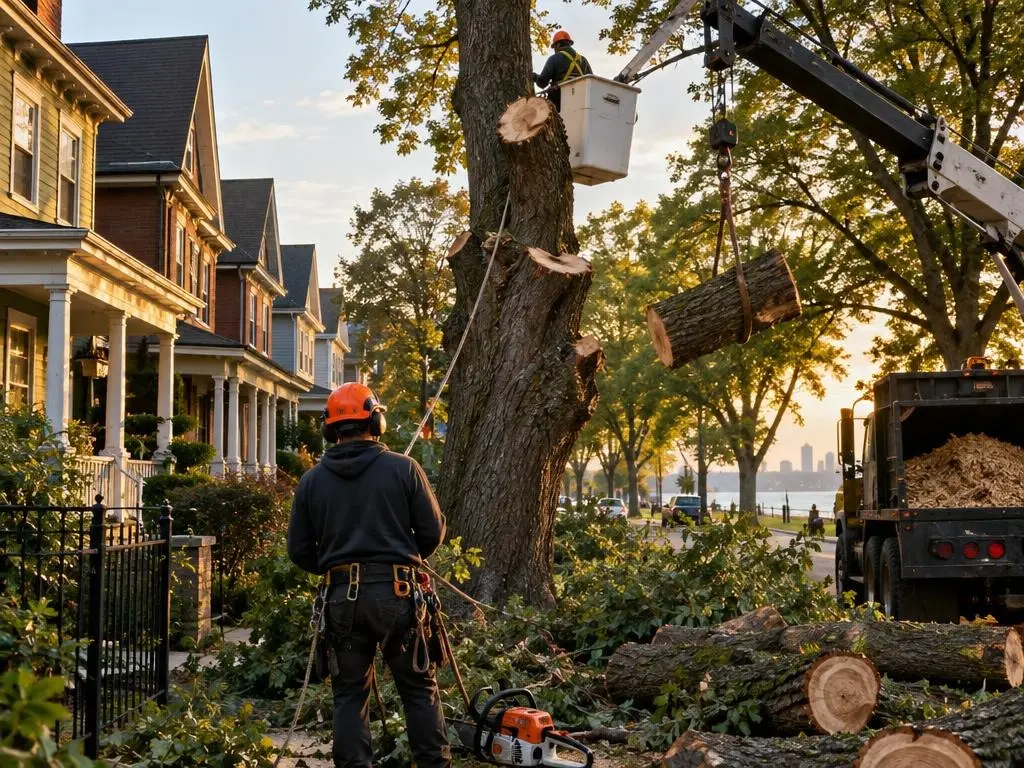
The quote states whether a tree will be felled, taken down in rigged sections, or removed with a lift or crane, and what will be protected underneath.
Prices on paper
Each tree, stump and cleanup item gets its own line and price. Changes in scope are agreed with you before any extra work happens.
Cleanup decided ahead
You choose before the job whether logs stay cut to length, get split, or leave with the brush, so nothing ends up piled at the curb that the city will not take.
Common Questions
Do I need a permit to remove a tree in Buffalo?
For trees in the city right-of-way, usually the strip between the sidewalk and the curb, yes: work on them needs a Tree Work Permit from the Division of Parks and Recreation, filed at least 30 days ahead, and a city-licensed contractor. There is no fee for that permit. When tree removal is part of a building or development project that needs a city permit, Chapter 467 of the City Code also requires a site plan showing the trees and written permission to remove trees over 10 inches in diameter. If you are unsure which applies, we check before quoting.
Who takes care of the tree between the sidewalk and the street?
The City of Buffalo. Call 311 or use the online 311 form to request an inspection, pruning or removal. The city removes street trees that are dead or dying, structurally unsound, or carrying a disease that cannot be treated, and it does not usually take out a healthy tree just because its roots are lifting the sidewalk.
How much does tree removal cost in Buffalo?
Homeyou's October 2026 Buffalo guide puts a medium tree at about $552 to $748, and This Old House lists a Buffalo average of about $856, with most jobs between $417 and $1,835. Large trees over houses, dead ash and backyard trees that have to be lowered in pieces cost more, and Angi puts hard-to-reach or unsafe sites at 25 to 50 percent above normal. The written estimate we give you after seeing the tree is the price.
A tree came down in a storm. What should I do first?
Get everyone away from the tree and any wire it touches, and treat every downed line as live. Call 911 or National Grid for lines, then take photos of the tree and the damage for your insurer before anything is moved. Call us at (716) 475-9224 to leave the details at any hour; storm calls are scheduled in order of danger, with trees on houses and blocked exits first.
Is winter a good time to take down a tree here?
Often, yes. Frozen ground carries equipment across lawns and beds with far less damage, the leaves are off so the crew can see the structure of the tree, and there is less to clean up. Deep snow and ice can make a job slower, and a tree that is an immediate hazard should not wait for a season.
My ash tree is thinning at the top. Does it need to come down?
Thinning in the upper crown, woodpecker damage, vertical bark splits and sprouts along the trunk are classic signs of emerald ash borer, which has been in Erie County since 2011. A tree that is still mostly healthy can sometimes be treated, but once it is dead it turns brittle fast, and removal gets harder and more expensive every season. If it can reach your house, a driveway or a street, it is worth having it looked at now.
Who handles branches touching the wire to my house?
National Grid trims around its high-voltage lines, but the service drop from the pole to the house is the homeowner's responsibility. For a city street tree touching that wire, the city's Forestry office asks residents to call 311. For a tree on your own lot, we can arrange a temporary disconnect with National Grid, which needs at least five days' notice.
Is there a tree company near me that hauls everything away?
We work across Buffalo and Erie County, and hauling is part of every quote unless you ask to keep the wood. City curbside pickup takes only small branches tied in bundles no longer than four feet, so a full tree removal normally needs the debris hauled. Ash wood stays local under New York's rules on moving firewood.
Where You Will Find Our Crews
Buffalo itself comes first: Elmwood Village and the West Side, Parkside and North Buffalo near Delaware Park, Black Rock and Riverside along the Niagara, South Buffalo around Cazenovia and South Park, and the East Side neighborhoods where many lots have stood half-empty and trees have grown up unmanaged. City jobs usually mean tight access, overhead wires along the lot lines and a check on whether the tree is a city street tree.
From there we work through the inner ring and beyond. Kenmore and the Town of Tonawanda have the same narrow lots and old street trees as the city. Amherst, Williamsville and Clarence have bigger yards, more open woods and the wet lake-plain soils that let trees tip over in spring storms. Cheektowaga, Depew and Lancaster still have ash scattered through back yards. West Seneca, Lackawanna, Orchard Park and Hamburg in the Southtowns get some of the heaviest lake-effect bands, and the ground gets hillier the farther south you go. Grand Island has wide lots, shoreline wind and woodland edges. If you are near Buffalo and not sure we cover your street, call and ask.
- Tree Removal in Buffalo, NY
- Tree Removal in Amherst, NY
- Tree Removal in Cheektowaga, NY
- Tree Removal in Tonawanda, NY
- Tree Removal in Kenmore, NY
- Tree Removal in West Seneca, NY
- Tree Removal in Lackawanna, NY
- Tree Removal in Hamburg, NY
- Tree Removal in Orchard Park, NY
- Tree Removal in Lancaster, NY
- Tree Removal in Depew, NY
- Tree Removal in Clarence, NY
- Tree Removal in Williamsville, NY
- Tree Removal in Grand Island, NY
- Tree Removal in East Aurora, NY
- Tree Removal in North Tonawanda, NY
- Tree Removal in Niagara Falls, NY
- Tree Removal in Lockport, NY
- Tree Removal in Lewiston, NY
- Tree Removal in Wheatfield, NY
- Tree Removal in Elma, NY
- Tree Removal in Blasdell, NY
- Tree Removal in Alden, NY
- Tree Removal in Evans, NY
Tree Removal Services
Six services cover nearly every tree job on Buffalo-area homes, from one storm-split maple to a dead ash that needs a crane.
Tree Removal
Dead, leaning, cracked and unwanted trees taken down in rigged sections or felled where there is room, with the wood handled your way.
Learn more →Emergency Storm Tree Removal
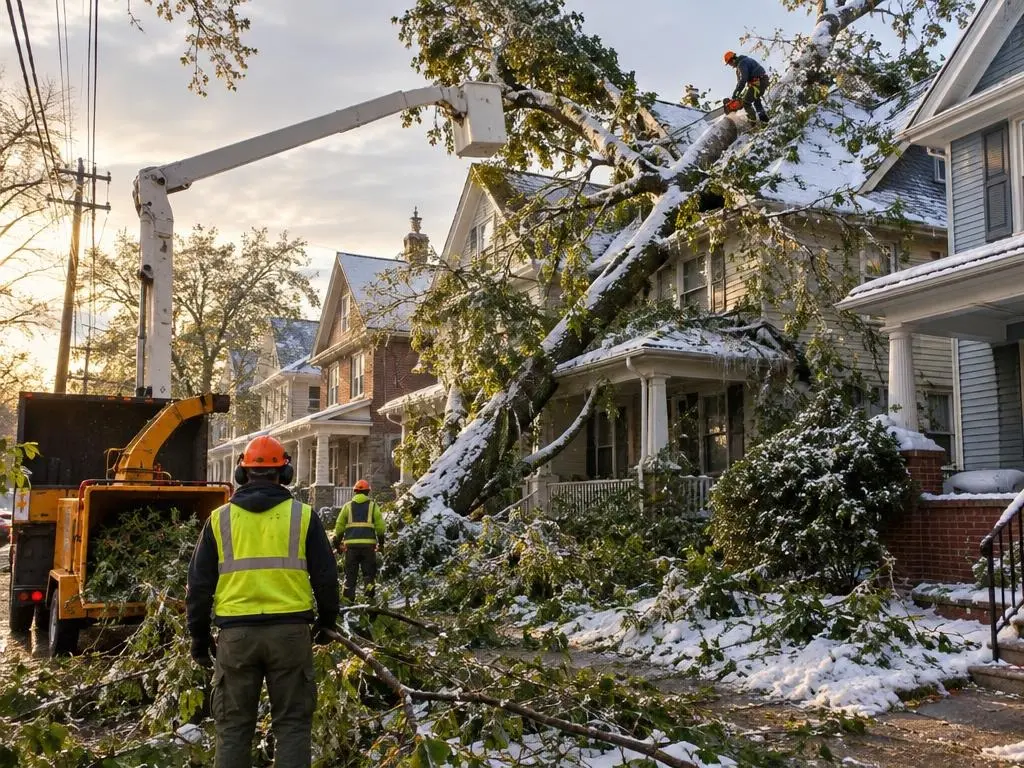
Trees and limbs on roofs, cars, fences and driveways after lake-effect snow, ice or windstorms, cleared in order of danger.
Learn more →Ash Tree Removal
Ash trees killed or failing from emerald ash borer, taken down before brittle dead wood makes the job riskier.
Learn more →Crane-Assisted Tree Removal
Large, dead or hard-to-reach trees lifted out piece by piece over houses and garages when climbing or felling is not safe.
Learn more →Tree Trimming & Pruning
Deadwood out, heavy limbs shortened before snow season and clearance over roofs and drives, cut to ANSI A300 standards.
Learn more →Stump Grinding & Removal
Stumps ground below grade with chips cleaned up, or dug out with roots when you need the ground for something else.
Learn more →Request Your Free Tree Removal Quote
Free on-site estimates across Buffalo and Erie County, with a written price for every tree.